01 Jun Everything About Child Immunisation: Benefits, Myths & 2026 Latest Updates
Everything About Child Immunisation: Benefits, Myths & 2026 Latest Updates
By Island Hospital | 1 June 2026. 10:00:00 AM
In recent years, Malaysia has seen worrying upticks in preventable diseases such as pertussis (whooping cough) and measles that were once largely under control.
These outbreaks highlight that immunisation gaps can quickly become public health risks.
To protect children, the Ministry of Health Malaysia runs the National Immunisation Programme (NIP) which is a comprehensive, government-funded schedule that shields children from life-threatening diseases from birth through adolescence.
This guide will help you:
What Is Child Immunisation & How Does It Work
Before looking at vaccination schedules, it’s essential to understand how immunisation protects your child.
Vaccines contain a weakened or inactive form of a virus or bacteria. When injected, this safe exposure trains your child’s immune system to:
- Recognise harmful germs quickly
- Produce protective antibodies
- Build immune memory for faster future responses
As a result, your child develops strong immunity without having to suffer the actual disease.
Why This Matters for Your Child
Immunisation acts as a prevention and protection during your child’s most vulnerable years as:
- Natural infections can be severe or life-threatening, especially in infants
- Young children have underdeveloped immune systems, making them less able to fight infections
- Maternal antibodies (including from breast milk) fade over time and cannot fully protect against many serious diseases
In short, vaccines act as a safe training system for the immune system, giving your child the protection they need before they’re exposed to real risks.
Key Benefits of Childhood Immunisation
1. Protects Against Life-Threatening Diseases
Vaccines shield children from serious and potentially fatal illnesses, including:
- Tuberculosis
- Hepatitis B
- Polio
- Measles
- Pneumonia
Without protection, these diseases can lead to brain damage, lifelong disability, or even death.
2. Protects Babies When They’re Most Vulnerable
Infants face the highest risk of severe infections especially in their first year of life.
Vaccination provides an early layer of protection, helping safeguard them before their immune systems are fully developed.
3. Strengthens Community Protection (Herd Immunity)
When more children are vaccinated:
- Disease transmission is reduced
- Vulnerable groups (e.g. newborns, immunocompromised individuals) are protected
- The risk of outbreaks is significantly lowered
This explains why every child’s vaccination contributes to public health and not just individual protection.
4. Safer Than Natural Infection
Relying on natural infection means a child must first become ill, which can result in:
- Severe complications
- Hospitalisation
- Long-term health issues
Vaccines offer the same immune protection without exposing your child to these dangers.
5. Proven to Save Millions of Lives
Childhood immunisation is one of the most successful medical advancements in history.
It is estimated to save 2–3 million lives globally every year, reducing the burden of preventable diseases worldwide.
The Malaysia National Immunisation Programme (NIP) Schedule
The Malaysia National Immunisation Programme (NIP), led by the Ministry of Health, provides free, essential vaccines for children at government clinics (Klinik Kesihatan) nationwide, protecting them from serious infectious diseases from birth through adolescence.
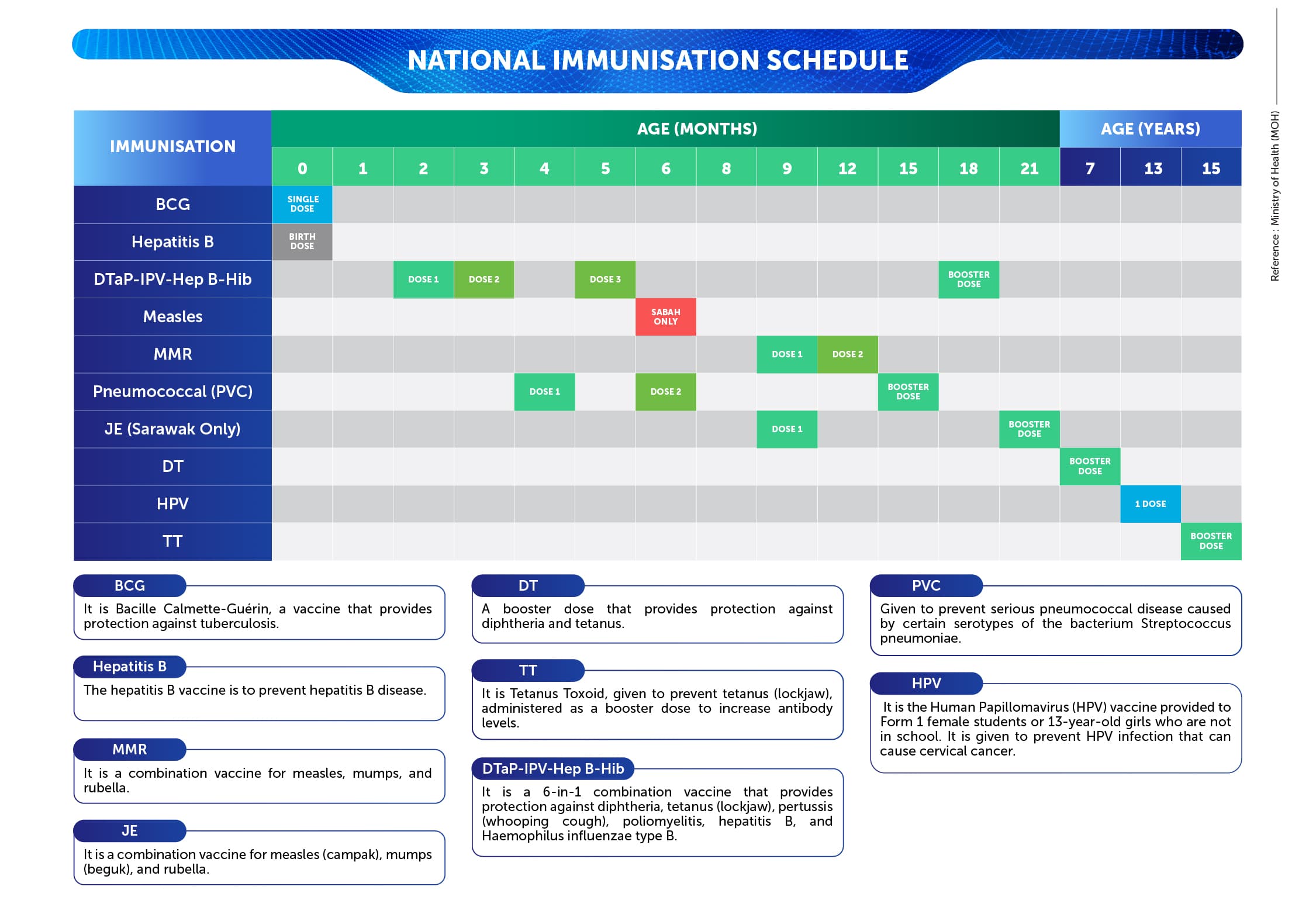
The 6-in-1 Vaccine
Malaysia now uses combination vaccines like Hexaxim or Infanrix Hexa, covering:
- Diphtheria
A bacterial infection that causes a thick covering in the back of the throat, which can lead to breathing difficulties, heart failure, or even paralysis. - Tetanus (Lockjaw)
Caused by bacteria entering wounds; it leads to painful muscle spasms and stiffness, particularly in the jaw and neck muscles. - Pertussis (Whooping Cough)
A highly contagious respiratory disease characterized by severe coughing fits that make it difficult for infants to eat, drink, or breathe. - Polio
A viral disease that can invade the central nervous system, potentially causing permanent muscle weakness or total paralysis. - Hepatitis B
A viral infection that attacks the liver and can cause both acute and chronic disease, significantly increasing the risk of liver cancer later in life. - Haemophilus influenzae type b (Hib)
A bacterium that causes various severe illnesses in children under five, most notably meningitis (inflammation of the brain lining) and pneumonia.
Clinically, combination vaccines offer:
- Reduced injection burden per visit
- Improved patient comfort and compliance
- Equivalent immunogenicity and protection compared to separate vaccines
Closing the Protection Gap on NIP vs. Private Vaccines
Although the NIP provides essential protection, some important vaccines are not included in the routine schedule.
To ensure broader protection, paediatricians often recommend additional vaccines especially for children in higher-risk environments such as childcare or frequent travel.
Recommended Additional Vaccines
To provide broader coverage, doctors often recommend the following vaccines as complements to the NIP:
- Rotavirus: Protects against severe diarrhoea and dehydration, a common cause of hospitalisation in infants
- Pneumococcal (PCV): Expands protection against strains that can cause pneumonia, meningitis, and bloodstream infections
- Chickenpox (Varicella): Reduces the risk of complications and helps limit spread in schools or childcare
- Influenza (Flu): Offers yearly protection against evolving flu viruses that can lead to serious illness in young children
- Meningococcal: Important for travel or specific exposure risks (e.g. Hajj or Umrah)
Eczema in babies can be distressing. But with the right care, it can be effectively managed. Learn how to identify triggers, soothe flare-ups, and protect your baby’s skin in our comprehensive guide on Baby Eczema: Symptoms, Causes & Treatment.
Missed a Dose? Here’s What to Do
The good news is that if your child misses a scheduled vaccine, there’s no need to start over.
Immunisation can simply continue from where it left off, and your child can still achieve full protection with a proper catch-up schedule.
What You Should Do Next
- Visit your nearest Klinik Kesihatan or paediatrician
- Bring your child’s “Buku Biru” (health record)
- Follow a personalised catch-up schedule based on your child’s age and previous doses
Healthcare providers will adjust the timing safely to ensure your child receives all necessary protection.
Side Effects: What’s Normal vs Concerning
Most vaccines are well-tolerated, and side effects (if they occur) are usually mild and temporary. Knowing what to expect can help you respond to your child calmly and appropriately.
Common Reactions
These are expected and typically resolve within a few days:
- Mild fever
- Redness, swelling, or soreness at the injection site
- Fussiness or irritability
- Reduced appetite or sleepiness
These reactions are a sign that your child’s immune system is responding to the vaccine.
Rare but Serious Reactions
Seek medical attention promptly if your child experiences:
- High fever (above 39°C)
- Difficulty breathing or wheezing
- Swelling of the face or lips
- Severe rash or signs of an allergic reaction
Reassurance for Parents
Serious side effects are extremely rare, and vaccines used in Malaysia undergo strict safety monitoring and continuous evaluation.
However, if you’re unsure about your child’s symptoms, it’s always safest to consult your doctor or visit a clinic for advice.
Addressing Common Concerns (Safety, Halal & Myths)
It’s natural for parents to have questions or even doubts about vaccines. Here’s what you need to know to move forward with certainty:
Halal Considerations
Vaccines used in Malaysia’s NIP are:
- Free from porcine-derived ingredients
- Reviewed and permitted by local Islamic authorities
These rulings are made based on the principles of public health necessity and child protection, ensuring vaccines are suitable for Muslim families.
How Vaccine Safety Is Ensured
All vaccines in Malaysia are regulated by the National Pharmaceutical Regulatory Agency (NPRA).
Before approval, vaccines must pass strict requirements, including:
- Extensive clinical trials to ensure safety and effectiveness
- Ongoing safety monitoring even after public use
- Strict quality control and manufacturing standards
This ensures that every vaccine given is safe, effective, and carefully monitored.
Common Myth on “Natural Immunity Is Better”
The reality is: relying on natural infection means gambling with your child’s health.
Diseases like measles or meningitis that are commonly seen as “childhood rites of passage”, can lead to lifelong disability or even death.
To prevent these serious complications, vaccines are the safer shortcut in which they train the body to fight back without the trauma of getting sick first.
Autism spectrum disorder is a lifelong developmental condition that benefits greatly from early intervention and structured support. Explore practical next steps and care options in our in-depth guide: My Kid Has Autism: What To Do Next.
Your Child’s Immunisation Is a Lifelong Investment
Childhood immunisation is one of the most important decisions you can make for your child’s future.
At Island Hospital, our team of paediatricians is committed to helping you protect your child through safe, timely, and comprehensive vaccination.
Our immunisation provides:
- Life-saving protection against serious and preventable diseases
- A shared responsibility that helps safeguard your family and the wider community
- A strong foundation for lifelong health, reducing risks well into adulthood
The earlier you act, the better protected your child will be.
FAQs
What does the NIP cover?
The programme protects children against 13 vaccine- preventable diseases, including:
| Category | Disease |
|---|---|
| Bacterial Diseases |
|
| Viral Diseases |
|
| Regional (Sarawak) |
|
| Respiratory Infection |
|
Quick Insight:
Many of these diseases are covered through combination vaccines, such as:
- 6-in-1 vaccine: protects against 6 diseases (DTaP-IPV-HepB-Hib)
- MMR vaccine: protects against 3 diseases (measles, mumps, rubella)
Why should I consider vaccines beyond NIP for my child?
Choosing additional vaccines alongside the NIP enhances your child’s protection based on real-world risks where it helps:
- Broaden strain coverage
Some diseases (like pneumococcal infections and influenza) have multiple strains. Additional vaccines can provide wider protection than what is included in the basic schedule. - Protect against common but serious illnesses
Conditions like rotavirus and chickenpox are widespread and can lead to complications or hospitalisation, especially in younger children. - Change exposure risks
Children today are more exposed through childcare, travel, and urban environments, increasing the likelihood of encountering certain infections. - Prevents disruption to daily life
Vaccination helps reduce missed school days, parental work disruptions, and the stress of managing preventable illnesses.
Are you keeping up with your child’s immunisation?
Use this quick checklist to make sure your child stays on track:
Do vaccines cause autism?
There is no evidence that vaccines cause autism. Extensive research involving millions of children worldwide has consistently shown no link between vaccines and autism.
Major health organisations, including the CDC, the World Health Organisation (WHO), and the American Academy of Pediatrics have also confirmed that vaccine ingredients do not cause autism spectrum disorder.
Are vaccines safe for babies?
Yes. Vaccines used in Malaysia are carefully evaluated and continuously monitored by the National Pharmaceutical Regulatory Agency (NPRA) to ensure they meet strict safety and effectiveness standards.
Before approval, vaccines undergo:
- Rigorous clinical testing
- Strict quality and manufacturing checks
- Ongoing safety monitoring even after they are in use
Serious side effects are extremely rare, while the benefits of vaccination in preventing dangerous diseases are well-established and far outweigh the risks.