

25 May Why Is My Lymph Node Swollen? 5 Common Causes and Treatments
Why Is My Lymph Node Swollen? 5 Common Causes and Treatments
By Island Hospital | 25 May2026. 10:00:00 AM
Ever felt a small, marble-like lump in your neck and immediately wondered if something was wrong? In most cases, there’s no need to panic as this is normal.
Swollen lymph nodes are usually a normal response to everyday issues like a cold, minor infection, or even dental work. In simple terms, they’re part of your body’s defense system kicking into action.
That said, not all swelling should be ignored.
In this guide, you’ll learn what causes swollen lymph nodes, how to tell the difference between harmless and concerning symptoms, and exactly when to seek medical attention.
Swollen Lymph Nodes and Why It Happens
Your lymphatic system is a network of vessels and nodes that filter fluid throughout your body. Unlike your blood, which is pumped by the heart, lymphatic fluid relies on your physical movement to circulate.
Swollen lymph nodes are small glands that become enlarged when your immune system is actively fighting infections or inflammation.
The Common Causes
- Dental Issues: Did you know a vigorous dental cleaning or a mild case of gingivitis can cause the nodes under your jaw to swell? The mouth is the primary entry point for bacteria, making these nodes the most active in the body.
- Ear and Skin Infections: A middle ear infection or even minor skin irritations can trigger a response. A new hair dye, a bug bite on the scalp, or a small pimple near the ear can specifically activate the “auricular” nodes behind your ears.
- Post-Vaccine Response: It is common for nodes in the armpit to swell after a flu or mRNA vaccine. This is a “training exercise” for your immune system and typically resolves in a few weeks.
- Common Cold or Flu: These are the most frequent culprits. When your body fights off a viral respiratory infection, the lymph nodes in your neck often enlarge as they ramp up white blood cell production to clear the virus.
- Cat Scratch Disease: Even a minor scratch or bite from a kitten can lead to swelling in the nodes closest to the injury (usually the armpit or neck). This is a bacterial response that typically presents a few weeks after the scratch occurs.
In most cases, they’re harmless and temporary.
However, if a lymph node is hard, painless, growing over time, or doesn’t go away after a few weeks, it could signal something more serious and should be checked by a doctor.
Where Are Your Lymph Nodes Located?
Lymph nodes are can be found throughout your body, but the most noticeable clusters are:
- Neck (cervical nodes)
- Under the jaw
- Armpits (axillary nodes)
- Groin (inguinal nodes)
- Above the collarbone (supraclavicular nodes) which doctors watch more closely
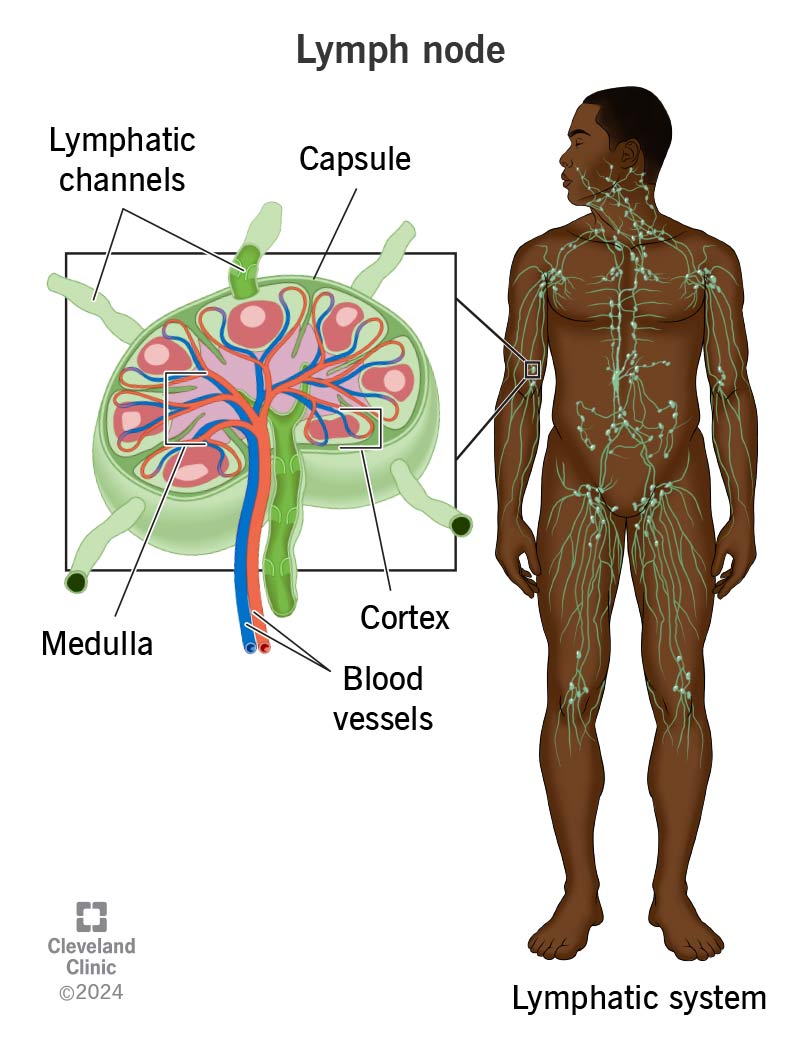
These areas act like checkpoints, filtering harmful substances and activating immune responses.
As these nodes drain fluid from the chest and abdomen, swelling even if it doesn’t hurt is often treated with higher clinical urgency.
Swollen Lymph Node Texture Guide
The way a lymph node feels and moves can offer insight into why your immune system is reacting.
While only a medical professional can provide a diagnosis, these characteristics are common indicators:
| Texture / Feature | Typical Indication | Clinical Context |
| Soft & Movable | Reactive Node | These often feel like a grape or a small rubber ball that slides under the skin. This usually suggests a temporary response to a minor infection. |
| Tender or Painful | Acute Inflammation | Soreness often means the node is rapidly expanding to filter out bacteria or a virus. This is a common sign of the body actively fighting an infection. |
| Hard or Fixed | Potential Concern | Nodes that feel "stony," hard, or are firmly anchored in place (do not move when pushed) require a prompt medical evaluation to rule out more serious conditions. |
When a Lymph Node is Considered Swollen
Size and duration are just as important as texture. Medical professionals generally use the following benchmarks to determine if a node is clinically enlarged:
- The Size Rule: A lymph node is typically considered “swollen” (lymphadenopathy) if it measures more than 1 centimeter (about 0.4 inches) in diameter.
- The Duration Factor: Swelling that persists for more than two to four weeks without signs of shrinking should be evaluated by a doctor, even if the bump is painless.
- Widespread Swelling: If you notice swollen nodes in multiple areas at once (e.g., the neck, armpits, and groin simultaneously), this is often a sign of a systemic issue rather than a localised infection.
The “4-Week Rule” and the “Shotty” Node
One of the most common concerns people have is: “Why is my lymph node still swollen even though I feel fine?”
Our immune system doesn’t switch off overnight. Even after an infection (like a cold or sore throat) has cleared, lymph nodes can remain enlarged for 2 to 4 weeks as they slowly return to their normal size.
This lingering swelling is completely normal and is often part of the healing process.
Tip:
Keep a brief log of when you first noticed the swelling and whether it has grown, shrunk, or changed in texture. This data is incredibly helpful for your doctor.
What is a “Shotty” Node?
In some cases, lymph nodes don’t fully shrink back to their original size. Instead, they become small, firm, and stable over time. These are often referred to as “shotty” lymph nodes.
The term comes from their texture where they feel like tiny pellets (pea-sized) under the skin.
Think of them as leftover “battle marks” from past infections. Just like scar tissue, they’re a sign your immune system has done its job before.
Most importantly, shotty lymph nodes are usually harmless, especially if they:
- Stay the same size
- Feel small and mobile
- Aren’t painful
Many believe a painless lymph node swelling is a good sign, but the truth is often more complex. Find out which symptoms are actually ‘red flags’ for Nasopharyngeal Cancer in our latest guide.
When Should I See a Doctor?
While most swollen nodes are just signs of a busy immune system, certain “red flags” mean it’s time to get a professional opinion. Use this checklist to monitor your symptoms:
- Unexplained weight loss (10% of body weight in six months) without changes to diet or exercise
- Drenching night sweats (needing to change your pajamas or sheets)
- A persistent, low-grade fever with no clear cause
- Redness, inflammation, or skin that feels hot to the touch over the site of the node
- Difficulty swallowing or breathing particularly if the swelling is located in the neck or under the jaw
The Cancer Connection: When Swelling is a Signal
It is the question everyone asks but dreads: “Could this be cancer?” While the vast majority of swollen lymph nodes are “reactive” (responding to a temporary threat like a virus), lymph nodes do play a role in oncology.
How Cancer Affects the Lymph Nodes
Cancer interacts with the lymphatic system in two primary ways:
- Primary Lymphoma: This is cancer that starts inside the lymphatic system itself. Because the node is the source, it swells as abnormal white blood cells multiply uncontrollably.
- Metastasis (Spread): More commonly, cancer cells from a tumor elsewhere in the body (like the breast, lungs, or colon) “break off” and travel through the lymphatic fluid. The lymph node acts like a filter, catching these cells. The node then swells as it tries and fails to process the cancerous cells.
Signs that Warrant Investigation
In a clinical setting, doctors look for a specific “profile” that differs from a standard infection. While an infected node is often painful and soft, a node involved with cancer typically presents differently:
- Painless and Persistent: Surprisingly, some nodes often don’t hurt. If a node is enlarged but causes no discomfort and doesn’t shrink after several weeks, it requires a scan.
- The “Matted” Feel: In some cases, multiple lymph nodes may feel like they are “clumped” or stuck together, rather than being individual, movable grapes.
- Rapid Growth: A node that continues to get larger over days or weeks, rather than peaking and shrinking, is a priority for a biopsy.
Early detection is the most powerful tool in modern medicine. If you are concerned about a persistent lump, let our oncology and diagnostic teams provide the expert assessment you need.
How to Support Your Lymphatic System Naturally
Unlike your circulatory system, which has the heart to pump blood, your lymphatic system is a “passive” network.
It relies entirely on your body’s physical movement and hydration to keep fluid and toxins moving toward your lymph nodes for filtration.
1. Movement Is the “Pump”
Since the lymphatic system lacks a central pump, it depends on muscle contractions to push fluid through its vessels.
- Walking & Stretching: Even light activity acts like a manual squeeze for your lymph vessels.
- Deep Diaphragmatic Breathing: The change in pressure in your chest when you take deep belly breaths helps pull lymph fluid upward toward the neck, where it re-enters the bloodstream.
- Rebounding: Low-impact jumping (like on a small trampoline) is one of the most efficient ways to “flush” the entire system.
2. Hydration: “Oil for the Filter”
Think of your lymph fluid like the oil in a car’s filter system. When you are dehydrated, the fluid becomes thick and sluggish, making it harder for your body to transport immune cells.
- Consistent Water Intake: Sipping water throughout the day keeps the fluid thin and flowing smoothly.
- Limit Excess Salt: Too much sodium can cause fluid to “pool” in your tissues (edema), putting extra strain on your lymphatic vessels.
3. Gentle Self-Care & Recovery
When your nodes are actively “reactive” or swollen, you can support the recovery process with these simple steps:
- Warm Compresses: Applying a warm, damp cloth to a tender area for 10–15 minutes can improve local circulation and soothe discomfort.
- Adequate Rest: Your immune system does its most intensive “filtering” while you sleep. Prioritising rest allows your body to direct energy toward clearing the infection.
- Early Intervention: Managing minor skin nicks, dental hygiene, and seasonal allergies early prevents your lymphatic system from becoming “overworked.”
How Your Lifestyle Shapes Your “Normal” Heart Rate
There’s no single “perfect” heart rate that applies to everyone. Your baseline is heavily influenced by how you live.
If you’re physically active or an athlete, a lower resting heart rate is often a sign of efficiency and good cardiovascular fitness. On the other hand, if you spend most of your day sitting, your resting heart rate may be slightly higher.
High stress levels can lead to frequent spikes, even when you’re not physically active. Similarly, poor sleep or chronic fatigue can keep your resting heart rate elevated.
Ultimately, your “normal” isn’t defined by a number alone, it’s shaped by your habits, environment, and overall health.
Care and Treatment for Swollen Lymph Nodes
When dealing with swollen lymph nodes, the focus is usually on treating the underlying cause rather than the node itself.
Since swelling is a symptom of your immune system in action, the nodes typically return to their normal size once the primary issue is resolved.
At-Home Management
For nodes swollen due to minor infections (like a cold or flu), you can manage the discomfort with these steps:
- Warm Compresses: Applying a warm, wet washcloth to the affected area can help soothe tenderness.
- Over-the-Counter Support: Pain relievers can reduce inflammation and ache, though they won’t “cure” the swelling itself.
- Rest and Hydration: Allowing your body to recover helps your immune system finish its work faster.
Professional Medical Treatment
If the swelling is caused by something more specific than a common virus, a doctor may prescribe targeted treatments:
- Antibiotics or Antivirals: Used if the swelling is linked to a specific bacterial or viral infection.
- Draining an Abscess: In rare cases where a node becomes infected and collects pus, a medical professional may need to drain it.
- Addressing Chronic Conditions: If the swelling is tied to an immune disorder or other underlying health conditions, treatment will focus on managing that specific diagnosis.
Treatment is most effective when started early. It is vital to seek a medical evaluation if swollen lymph node(s) persists or if you notice any red flags requiring immediate medical attention.
Is it just swollen lymph nodes or a lymphoma? Delve into practical strategies to reduce your lymphoma risk and the importance of a proactive approach to healthcare in this article: Can I Prevent Lymphoma? (Risk Factors & Prevention Tips).
Trusting Your Body’s Internal Defense
Discovering a swollen lymph node can be unsettling, but it’s important to remember its primary purpose: protection.
These small, bean-shaped glands are the frontline heroes of your immune system. Whether they are reacting to a common cold, a dental visit, or a minor scratch, their swelling is a sign of a high-functioning internal defense system.
Take the next step if you notice a persistent lump that has lasted longer than a month, or if you’re experiencing “B-symptoms” like night sweats and unexplained fatigue.
At Island Hospital, our doctors can help you perform a simple “palpation” (feeling the node) to determine if further imaging, like an ultrasound, is necessary.
Don’t let uncertainty linger. Schedule a consultation with our specialists today for the expert answers and peace of mind you deserve.
FAQs
Can stress cause swollen lymph nodes?
Stress by itself doesn’t directly cause swollen lymph nodes. However, prolonged stress can weaken your immune system, making it easier for your body to catch infections like colds or throat infections which can lead to swollen lymph nodes.
In other words, stress is more of an indirect trigger rather than a direct cause.
How long do reactive lymph nodes stay swollen?
Reactive lymph nodes that respond to infection typically stay enlarged for about 2 to 4 weeks. In some cases, they may take even longer to return to normal size, especially if your immune system is still recovering.
As long as they are gradually shrinking and not getting worse, this is usually a normal healing process.
Should I massage swollen lymph nodes?
Gentle massage may help encourage lymphatic drainage and reduce discomfort. However, avoid pressing too hard or repeatedly irritating the area, as this can make swelling worse. If the lymph node is painful, rapidly growing, or you’re unsure, it’s best to leave it alone and seek medical advice.
Can allergies cause swollen lymph nodes?
Yes, allergies can sometimes cause mild lymph node swelling because they activate your immune system. However, this swelling is usually less pronounced than what you’d see with an infection.
If the swelling is significant, persistent, or accompanied by pain or fever, another cause may be more likely.
How are locations of swollen lymph nodes a cue in detecting cancer?
The location of the swelling helps doctors “trace” the source. For example:
- Swelling in the axilla (armpit) may prompt a breast exam or mammogram.
- Swelling in the neck may lead to an investigation of the throat, thyroid, or mouth.
- Swelling above the collarbone is a critical checkpoint for internal organs.
Related Doctors
Latest Blog Posts

July 20, 2026
July 18, 2026