


10 Dec The Power of Accreditation: How Global Standards Safeguard Your Treatment
The Power of Accreditation: How Global Standards Safeguard Your Treatment
By Island Hospital | Dec 10, 2025 12:00:00 PM
You’ve probably heard of accreditation before — schools have it, universities have it, even businesses have it. But in healthcare, accreditation is far more than a certificate on the wall. It’s a powerful assurance that a hospital’s safety, quality, and clinical outcomes have been independently verified against international standards.
Beyond shaping reputation, accreditation strengthens accountability and drives ongoing improvement, ensuring that every diagnosis, treatment, and recovery is delivered with precision, consistency, and compassion.
That’s why international accreditation matters. It gives patients confidence that their hospital follows globally recognised best practices, where safety, quality, and care always come first.
In this article, we’ll take you behind the scenes to explore how international accreditation works and why it plays a vital role in safeguarding your treatment at every step.
How International Accreditation Works
Accreditation in healthcare isn’t granted overnight — it’s the result of a rigorous, multi-step process that evaluates a hospital’s performance against globally recognised standards of quality and safety. The goal is simple: to ensure that every patient receives care that is effective, consistent, and centred on their wellbeing.
1. Evaluation Against International Standards
Hospitals seeking accreditation must first undergo a detailed self-assessment, measuring their systems, processes, and outcomes against established frameworks.
Independent surveyors, often medical professionals and healthcare auditors, then conduct on-site inspections to verify compliance with hundreds of measurable criteria.
These criteria typically assess:
- Patient safety and clinical risk management
- Leadership and governance
- Infection control and facility management
- Medication safety and clinical documentation
- Staff training, communication, and continuous education
- Patient rights, satisfaction, and overall experience
Each area is evaluated through observation, staff interviews, and document reviews to ensure that hospitals don’t just meet standards once, but uphold them in daily practice.
2. Continuous Improvement and Reassessment
Accreditation isn’t a one-time achievement. Hospitals must maintain their standards through ongoing monitoring and periodic reassessment, typically every 3 to 4 years.
This cycle ensures that they continue to improve in step with evolving medical evidence, new technologies, and international best practices.
3. Example Standards and Accreditation Bodies
Different accreditation organisations have unique frameworks, but all share a commitment to patient safety and quality care.
Here’s how some of the most respected accreditation systems work:
- Australian Council on Healthcare Standards (ACHS) and ACHS International (ACHSI)
The ACHS is globally recognised for its Evaluation and Quality Improvement Program (EQuIP) framework, which promotes quality enhancement, patient-centred care, and measurable outcomes through both internal self-assessment and independent external review.
Through its international arm, ACHS International (ACHSI) hospitals can also earn specialised designations such as Centres of Excellence (CoE). This program acknowledges departments or services that demonstrate outstanding leadership, innovation, and multidisciplinary teamwork. - Malaysian Society for Quality in Health (MSQH)
The MSQH sets national standards aligned with global benchmarks, focusing on governance, risk management, and clinical service delivery. Hospitals must demonstrate compliance with their 6th Edition Hospital Accreditation Standards, which cover over 500 criteria across all departments. - Joint Commission International (JCI)
One of the world’s most widely recognised accreditation bodies, JCI sets global standards for quality and patient safety in hospitals and healthcare organisations. Its framework focuses on leadership, infection prevention, medication management, and patient rights.
JCI accreditation is often regarded as a gold standard among hospitals that cater to international patients or participate in medical tourism. - DNV International Accreditation for Hospitals (DNV-GL Healthcare)
Originating from Norway, DNV-GL integrates hospital accreditation with ISO 9001 quality management principles, blending safety standards with data-driven performance improvement.
DNV accreditation emphasises risk management, clinical effectiveness, and patient-centred culture, making it popular among hospitals aiming for operational excellence. - Healthcare Information and Management Systems Society (HIMSS) EMRAM
While not a traditional hospital accreditation, HIMSS EMRAM (Electronic Medical Record Adoption Model) certifies hospitals on their level of digital transformation, from basic IT adoption to advanced electronic medical record integration.
A Stage 5 certification and above indicates that a hospital effectively uses digital systems to support patient safety, decision-making, and efficiency. - ISO 15189: Medical Laboratories – Requirements for Quality and Competence
This ISO standard focuses specifically on medical laboratories, ensuring that diagnostic services deliver accurate, reliable, and timely results.
ISO 15189 accreditation enhances the credibility of laboratory testing by verifying competence, calibration, and process control — all critical for accurate patient diagnosis and treatment.
Curious about why accreditation matters in healthcare? This article explains how ACHSI elevates care standards and what it means for your health journey.
Benefits of International Accreditation

International accreditation plays a vital role in bridging the gap between healthcare promise and healthcare delivery. It ensures that hospitals don’t just say they provide quality care — they can prove it through verified performance, safety standards, and measurable outcomes.
1. Assurance of High-Quality Care and Accurate Clinical Outcomes
Accreditation serves as an independent assessment of a hospital’s performance across every area of care, from infection control and patient safety to staff training and clinical effectiveness.
Hospitals that meet these international standards demonstrate that their systems and outcomes are not only safe but also consistently reliable.
2. Better Clinical Outcomes
Research has shown that accredited hospitals tend to deliver better clinical performance and patient outcomes. Accreditation helps ensure that care processes are standardised, effective, and regularly reviewed, reducing variability and errors while improving recovery and success rates across departments.
For patients, this means a higher level of confidence that every diagnosis, procedure, and treatment plan follows evidence-based best practices designed to achieve the best possible results.
3. Commitment to Continuous Improvement
Accredited hospitals don’t stop at meeting standards — they strive to exceed them.
Regular reassessments and audits ensure ongoing compliance with evolving standards, driving healthcare providers to continually evaluate performance, adopt new technologies, and stay aligned with international best practices.
This culture of continuous improvement keeps hospitals proactive — not just maintaining standards, but consistently raising them. As a result, patients benefit from care that evolves with medical advancements, new evidence, and emerging health challenges.
4. Building Patient Trust
When a hospital earns international accreditation, it sends a clear message: patients can trust that their care is guided by transparency, accountability, and integrity.
For those seeking treatment abroad, this trust becomes even more important.
Accreditation assures patients that the hospital upholds rigorous global standards for safety, ethics, and quality, reducing uncertainty and helping them make informed decisions about where to receive care.
5. Global Recognition and Confidence
Hospitals with international accreditation earn a mark of credibility that’s respected worldwide. Accredited institutions are recognised by peers, regulators, and international health bodies for their unwavering commitment to excellence.
This recognition strengthens their reputation and makes them trusted destinations for patients seeking advanced treatments or travelling abroad for specialised care.
Getting a full body screening for the first time? Here’s everything you need to know to make the most of your health check!
Island Hospital’s Global Standards of Excellence

Earning the trust of patients around the world begins with meeting global standards of excellence. Through internationally recognised accreditations, Island Hospital demonstrates its commitment to safe, evidence-based, and patient-centred care, reaffirming our place among the region’s most trusted healthcare institutions.
- Malaysian Society for Quality in Health (MSQH)
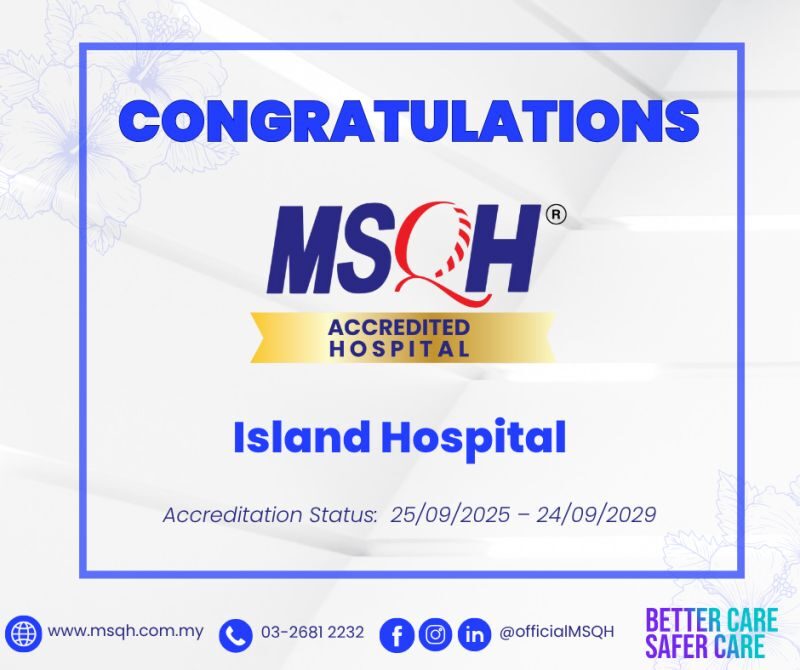
Island Hospital maintains ongoing accreditation from the MSQH, Malaysia’s leading healthcare standards body. This recognition ensures that every aspect of our care, from governance and clinical services to patient safety, meets national standards aligned with international benchmarks.
- Australian Council on Healthcare Standards (ACHS)
We are recognised by the ACHS, one of the world’s most respected accreditation organisations. This recognition validates our consistent performance in delivering safe, high-quality, and patient-centred care guided by the EQuIP (Evaluation and Quality Improvement Program) framework. - Centres of Excellence (CoE) by ACHS International
Island Hospital is proud to be acknowledged as a Centre of Excellence in three specialised fields: Cancer Care, Cardiology, and Gastroenterology. These recognitions highlight our leadership, clinical excellence, and multidisciplinary approach to delivering world-class treatment outcomes.
- HIMSS EMRAM Stage 5 CertificationIn addition, Island Hospital has achieved Stage 5 certification in the HIMSS Electronic Medical Record Adoption Model (EMRAM) — a milestone that reflects our strong commitment to digital transformation and the use of technology to enhance patient safety, efficiency, and clinical accuracy.
Each of these achievements reinforces our mission to deliver the best possible care, where compassion meets innovation, and quality is continuously elevated.
Island Hospital’s Centres of Excellence (COE)
Recognised by ACHS International (ACHSI) as Centres of Excellence, Island Hospital’s specialised programs in Cancer Care, Cardiology, and Gastroenterology reflect the hospital’s dedication to world-class standards in patient safety, clinical governance, and quality outcomes.
Each COE demonstrates how ACHSI accreditation translates into everyday excellence, where advanced medical expertise meets compassion, technology, and continuous improvement.
1. Gastroenterology Program

The Gastroenterology Program stands at the forefront of digestive health, offering comprehensive care for gastrointestinal, liver, pancreatic, and bowel conditions. Using advanced endoscopic and minimally invasive procedures, the centre ensures early detection, accurate diagnosis, and effective treatment.
Each patient receives personalised, evidence-based care from a dedicated team of gastroenterologists and specialists committed to safety, comfort, and lasting wellness.
2. Cardiology Program
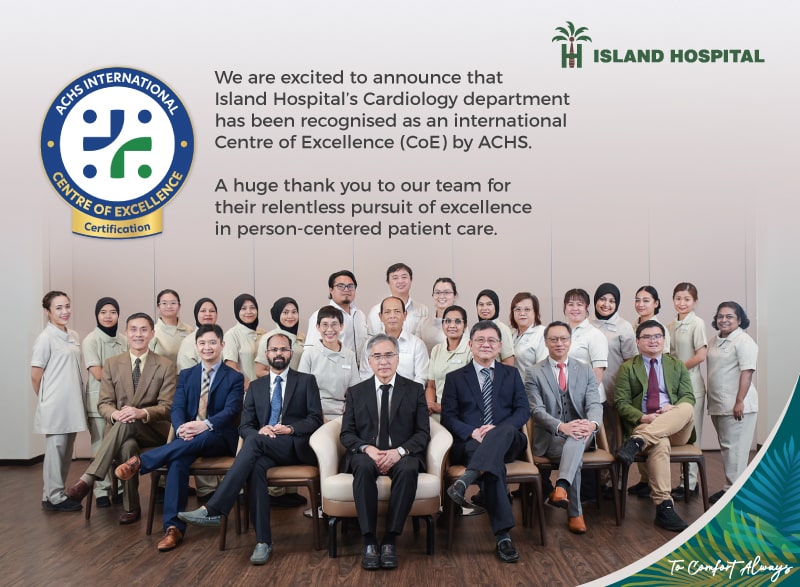
Island Hospital’s Cardiology Program represents the highest standard of cardiovascular care. From early detection and preventive screenings to advanced interventions and post-treatment rehabilitation, every service is delivered with precision and care.
Guided by internationally trained cardiologists and supported by cutting-edge diagnostic tools, the Cardiology COE provides seamless, patient-focused care that enhances both recovery and long-term heart health.
3. Cancer Care Program
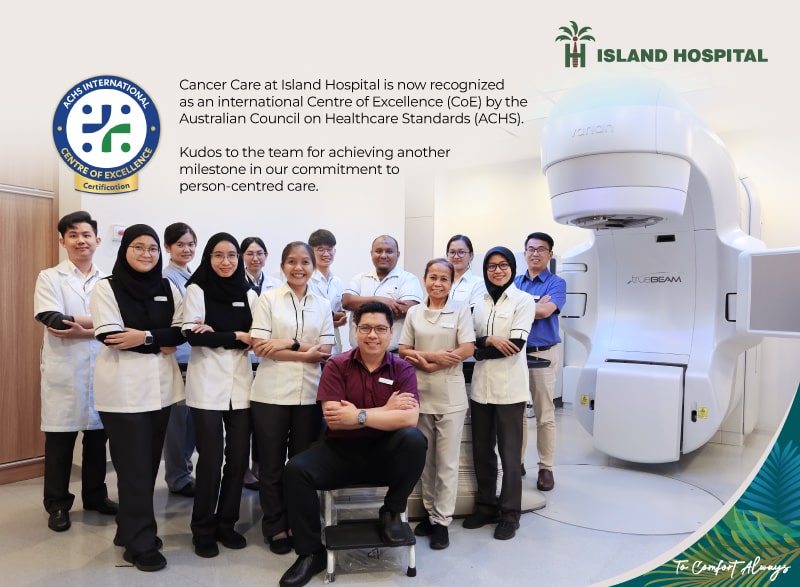
Island Hospital’s Cancer Care Program provides holistic oncology services that combine clinical expertise with empathy. From diagnosis to recovery, patients are supported by multidisciplinary teams of oncologists, surgeons, radiologists, and specialist nurses.
With access to state-of-the-art cancer diagnostics, chemotherapy, and targeted therapy, the centre ensures that every patient’s journey is guided by innovation, dignity, and compassionate care.
Where Global Standards Meet Personal Care
Experience the difference of care built on trust, compassion, and internationally recognised excellence. At Island Hospital, every treatment is guided by global safety and quality standards, delivered with the warmth and attention you deserve.
Whether you’re seeking specialised treatment or a routine check-up, you can rest assured that your health is protected by a hospital accredited to the highest international benchmarks.
Discover care that’s trusted worldwide — book your appointment today!
FAQ
What does international accreditation mean for patients?
International accreditation means that a hospital has been independently evaluated by a recognised global body to ensure it meets strict standards in patient safety, quality, and ethics. For patients, it’s a sign that their care follows proven, evidence-based practices and is continuously monitored for improvement.
What is the main accreditation for hospitals in Malaysia?
In Malaysia, the Malaysian Society for Quality in Health (MSQH) is the primary national accreditation body. It sets healthcare standards aligned with global benchmarks, ensuring that hospitals deliver safe, high-quality, and patient-centred care.
Does accreditation affect medical tourism?
Yes. Accreditation plays a crucial role in medical tourism by building trust among international patients. Accredited hospitals demonstrate transparency, accountability, and compliance with global standards, giving patients confidence to seek treatment abroad with peace of mind.

At Island Hospital, ACHSI accreditation stands as a cornerstone of our commitment to global excellence. As one of Malaysia’s Flagship Medical Tourism Hospital Programme finalists, Island Hospital continues to attract patients from around the world who seek trusted, high-quality, and compassionate care.
Are all accredited hospitals the same?
Not exactly. While all accredited hospitals meet core safety and quality standards, some go further by earning specialised recognitions, such as Centres of Excellence, for outstanding performance in specific fields, such as cardiology, oncology, or gastroenterology.
Does accreditation mean a hospital is better than one that isn’t accredited?
While accreditation isn’t the only indicator of quality, it is one of the strongest and most transparent ways to measure a hospital’s commitment to excellence.
Accredited hospitals, like Island Hospital, undergo rigorous evaluations that verify their practices against international benchmarks, offering patients added assurance and peace of mind.
Related Doctors
Latest Blog Posts

July 20, 2026

July 18, 2026